最初の手がかりは、韓国のプロスポーツの観客を対象にした研究です(Journal of Cleaner Production、2024年)。この研究では、さまざまな特徴を組み合わせた「グリーンスタジアム」を観客に選んでもらう実験(選択実験)が行われました。選択実験は、「どれが好きですか」と直接たずねるのではなく、特徴の組み合わせが違う選択肢の中から選んでもらうことで、人がそれぞれの特徴をどれだけ重く見ているかを推し量る方法です。
では、スタジアムの環境は、どのようにして「また来たい」という気持ちにつながるのでしょうか。中国スーパーリーグの観客1,284人を調べた2026年の研究(Frontiers in Psychology)は、スタジアムの景観や機能の感じ方が、観客の感覚・感情・行動・認知の体験を高め、その体験が「観戦を続けたい」という意思を高める、という流れを確かめました。
ここで大切な注意があります。この研究が調べたのはスタジアムの環境の感じ方全般であり、環境への取り組みそのものではありません。それでも、太陽光パネルや緑化、リサイクルの仕組みが「スタジアムの環境」の一部である以上、同じ経路で観客の体験に作用する可能性は十分にあります。さらに、台湾のプロバスケットボールの観客を調べた別の研究(Chen et al.、PLOS ONE、2025年)でも、観客どうしが一緒に価値を生み出す要素の一つとして、「試合の雰囲気」が独立して見つかっています。スタジアムの環境は、一人ひとりの体験だけでなく、観客どうしの体験の土台にもなっているのです。
4. 観客は一枚岩ではない:「大切にしたい」と「実際にする」の差
ただし、観客全員が同じように反応するわけではありません。スポーツイベントの来場者を調べた2024年の研究(Journal of Strategic Marketing)は、来場者を環境に配慮する意図と行動によっていくつかのグループに分けました。
Introduction: Is green investment actually reaching fans?
Solar panels, renewable energy, recycling schemes. At most clubs, a stadium's environmental initiatives are talked about as a cost, or as corporate responsibility: the right thing to do, but rarely seen as an investment in fans' satisfaction or in bringing them back.
I started looking into this because of a simple question. Is a stadium's environmental work really unrelated to how fans feel? If fans notice it and value it, then perhaps it could be rethought, not as an obligatory cost, but as an investment in the relationship with them.
So I followed the academic research on stadiums, spectators, environmental initiatives and loyalty. The answer turned out to be: there seems to be a link, but nobody has properly measured it yet. In this article I set out, in turn, what the research shows, what it doesn't yet show, and my own research and opinion.
1. Fans see value in a greener stadium
The first clue comes from a study of South Korean professional sports spectators (Journal of Cleaner Production, 2024). Spectators were asked to choose between "green stadiums" with different combinations of features: a choice experiment. Rather than asking people directly what they like, a choice experiment has them pick between options with different combinations of features, which lets researchers estimate how much weight people put on each one.
Spectators placed the greatest value on on-site renewable energy generation. Those with stronger norms about climate risk were also more willing to pay for these features. In other words, environmental initiatives are not a matter of indifference to fans: for at least some of them, they are worth paying for.
From the spectator's side, then, "environmental initiatives equal cost" doesn't necessarily hold. But saying you're willing to pay is not the same as actually buying tickets and coming back again and again. I return to that gap in section 4.
2. Turning invisible equipment into something fans can join in
Other examples change how initiatives are presented. Pavegen, the UK company behind floor tiles that generate power from footsteps, worked with the NFL's Minnesota Vikings on an interactive gameplay experience in which fans generated electricity with their own feet.
Much of a stadium's energy-saving equipment sits on the roof or in plant rooms, out of fans' sight. However good it is, if fans don't notice it, it doesn't become part of their experience. "I helped generate that power", by contrast, is something people remember and tell family and friends about. It is the moment an environmental initiative moves from behind the scenes into the fan experience.
This example is a company's own account of a project, not a study measuring its effect on satisfaction or return visits. Still, taken together with section 1, where the features fans valued were visible ones, it suggests that what matters is not only what an initiative is, but how it is shown to fans and how they can take part.
3. The stadium environment becomes "I want to come back" through experience
So how does a stadium's environment turn into "I want to come back"? A 2026 study of 1,284 Chinese Super League spectators (Frontiers in Psychology) found that how fans perceive a stadium's landscape and functions strengthens their sensory, emotional, behavioural and cognitive experience, and that experience in turn strengthens their willingness to keep attending.
This is described with the "S-O-R model": a stimulus (the environment) passes through an inner experience (the organism) to become an intention (the response). The key point is that the environment doesn't create "I want to come back" directly; it only becomes an intention by passing through the fan's experience. Put the other way round, improving the environment won't lead to return visits unless it actually changes how fans experience the day.
There is an important caveat. This study looked at perceptions of the stadium environment in general, not environmental initiatives as such. Still, since solar panels, greenery and recycling systems are part of that environment, it is quite plausible that they act on the fan experience through the same pathway. A separate study of Taiwanese professional basketball spectators (Chen et al., PLOS ONE, 2025) also identified "event atmosphere" as a distinct element of how spectators create value together. The stadium environment underpins not just each individual's experience, but the experience fans share with one another.
4. Fans are not all alike: the gap between wanting to be green and acting green
Not every spectator responds the same way, however. A 2024 study of sport event goers (Journal of Strategic Marketing) segmented attendees by their pro-environmental intentions and behaviours.
It found a notable gap between wanting to protect the environment and actually doing so. People who say they care about the environment don't necessarily act in environmentally friendly ways at the stadium. The "willingness to pay" in section 1 likewise needs to be kept separate from actual behaviour.
Two things follow. First, the same initiative will land with some groups and not others. Second, getting people to say in a survey that an initiative is good is not the same as changing their behaviour or their attendance. When thinking about the effect of an initiative, we need to look separately at who it reached, and whether it moved feelings or behaviour.
5. Loyalty builds slowly
A study of 1,732 users of 27 Spanish sports clubs (Humanities and Social Sciences Communications, 2024) found that clubs' green practices were linked to user loyalty.
What's interesting is how. Green practices worked more through perceived service quality than through satisfaction, and their effect showed up over the long term rather than the short term. Environmental work may be less about making people feel "that was fun" on the day, and more about gradually building a sense that "this club does things properly", deepening the relationship over time.
The people studied were club members who play sport, not fans who come to watch, so the findings can't simply be transferred to stadium spectators. Even so, the suggestion that environmental work is less a one-off goodwill boost and more something that deepens a relationship over time applies to stadiums too. If that's right, judging an initiative on a single match or a single season would be too soon.
6. From my own research: how fans break "sustainability" down
I'd like to add one piece of my own postgraduate research as a point of reference. It is a preliminary study that has not been peer-reviewed, based on responses from 181 spectators in Japan, so it does not carry the same weight as the peer-reviewed studies above.
In it, I trialled a questionnaire to measure how spectators perceive stadium sustainability: the Sport Stadium Sustainability Scale (SSSS). I originally expected 12 groupings and 55 questions, but the analysis organised spectators' perceptions into three domains, nine groupings (factors) and 45 questions.
The three domains of environmental, social and economic are not my own invention. Looking at sustainability through these three lenses is widely known as the "triple bottom line" (social, environmental and economic, also called "People, Planet, Profit"), a term coined by the British writer John Elkington in 1994. The idea is that a business's success should be judged not by profit alone, but also by its impact on society and the environment. The SSSS's three domains follow the same idea.
(Figure: sustainability as the overlap of environmental, social and economic concerns)
Social: "Comfort & Basic Accessibility", "Social Diversity & Community Engagement" and "Inclusive & Safe Access".
Economic: "Community-linked Adaptability" (serving as an emergency shelter, local food and drink), "Operational Efficiency" (smooth ticketing and entry) and "Local Economic Contribution" (local jobs, working with local businesses).
The takeaway is that, for spectators, "sustainability" is not one thing. Things they can see and use themselves (water dispensers, containers) were perceived separately from behind-the-scenes infrastructure (renewable energy, rainwater systems). This echoes the idea in section 2 of turning invisible equipment into something fans can join in. And beyond the environment, comfort, safety and ties to the local community were also part of what a "sustainable stadium" meant to them.
What this study shows, however, is only the shape of how spectators group these things. It did not test which groupings lead to satisfaction or to wanting to come back. With only 181 respondents, around 90% of them male and 80% aged 18 to 24, it also needs to be re-tested with larger and more varied audiences.
7. What we know, and what we don't yet
Put together, the research so far shows:
Spectators value visible environmental initiatives and are willing to pay for them.
How fans perceive a stadium's environment feeds, through their experience, into wanting to come back.
But responses differ between groups, and there is a gap between intention and behaviour.
The link between environmental initiatives and loyalty emerges over time.
Spectators may perceive "sustainability" as several distinct groupings (my own preliminary study).
What we don't yet know is just as clear. These studies differ in country, sport and population, and each looks at a different part of the picture: one at willingness to pay, one at perceptions of the environment in general, one at the loyalty of club members who play sport. What's missing is data that directly measures, as a single line, how much a given initiative moved a given club's fans towards satisfaction and wanting to return.
Research has shown us the individual parts. Connecting them into a single line takes measurement at each stadium, because every club's audience and every club's initiatives are different.
8. My view: if you're investing anyway, connect it to how fans feel
What follows is my opinion, not an established finding.
Whether environmental initiatives lead directly to fan satisfaction has not yet been proven. Even so, I believe they should. Clubs and stadium operators are putting money from limited budgets into solar panels, waste-sorting systems and water dispensers. It would be a waste for that investment to end up on the books as nothing more than a cost of social responsibility.
The point is not to "use green initiatives to pull in crowds". It is to make initiatives visible to fans, to let fans take part in them, and then to check whether their experience has actually improved as a result. What stadiums need now is a deliberate design that connects environmental investment to fan satisfaction.
That means knowing not only "did we do something good for the environment?" but "how did fans feel about it?" Which groups of fans noticed which initiatives, and how did they take them? Trying to answer that question is, I believe, the first step in turning environmental work into part of the relationship with fans.
Closing: unmeasured, it stays a cost
Install solar panels without measuring their effect, and on the balance sheet they remain a cost. Only once you know which group of fans an initiative reached, and through which psychological pathway, can you start talking about it as an investment.
Research already has psychological scales and statistical methods for measuring what goes on in fans' minds. Using them at the stadium itself to check whether an initiative actually meant something to these fans: isn't that kind of measurement something stadiums need too?
Is environmental work a cost or an investment? The answer may only come into view once we measure how fans feel.
Sources
Chen, C.-Y., Lin, Y.-H., Yang, C.-Y., Chou, Y.-L., & Yeh, T.-Y. (2025). Value cocreation among spectators in professional spectator sports events: Scale development and effects of social media strategies. PLOS ONE, 20(5), Article e0320927. https://doi.org/10.1371/journal.pone.0320927
Ge, X., Ouyang, N., Yang, M., Yue, F., Chen, W., Meng, S., & Tong, W. (2026). Research on the impact mechanism of environmental perception of stadium landscapes on sustainable spectatorship willingness from the perspective of embodied cognition: Based on the experience model of "body–environment" interaction. Frontiers in Psychology, 17, Article 1827670. https://doi.org/10.3389/fpsyg.2026.1827670
Konstantopoulos, I., Manoli, A. E., Ntzoufras, I., Chantzi, E., & Thamnopoulos, I. (2024). Understanding fans' responses to sustainability: A segmentation of sport event goers' pro-environmental intentions and behaviours. Journal of Strategic Marketing. Advance online publication. https://doi.org/10.1080/0965254X.2024.2424760
Lyu, S. O. (2024). Unveiling willingness to pay for green stadiums: Insights from a choice experiment. Journal of Cleaner Production, 434, Article 139985. https://doi.org/10.1016/j.jclepro.2023.139985
Morán-Gámez, G., Fernández-Martínez, A., Nuviala, R., & Nuviala, A. (2024). Influence of green practices on user loyalty in sport clubs. Humanities and Social Sciences Communications, 11, Article 1246. https://doi.org/10.1057/s41599-024-03773-0


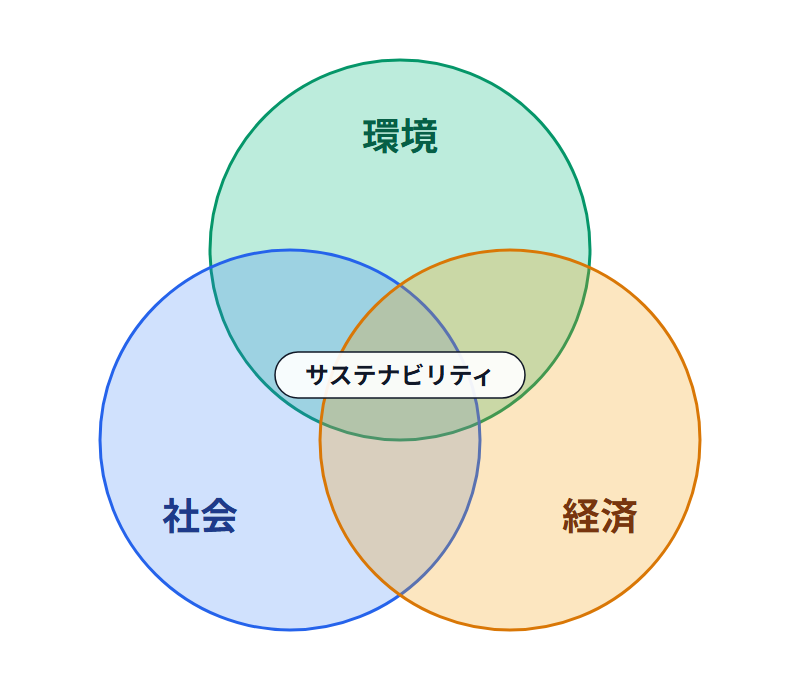 (図:サステナビリティを環境・社会・経済の3つの重なりとして捉える考え方)
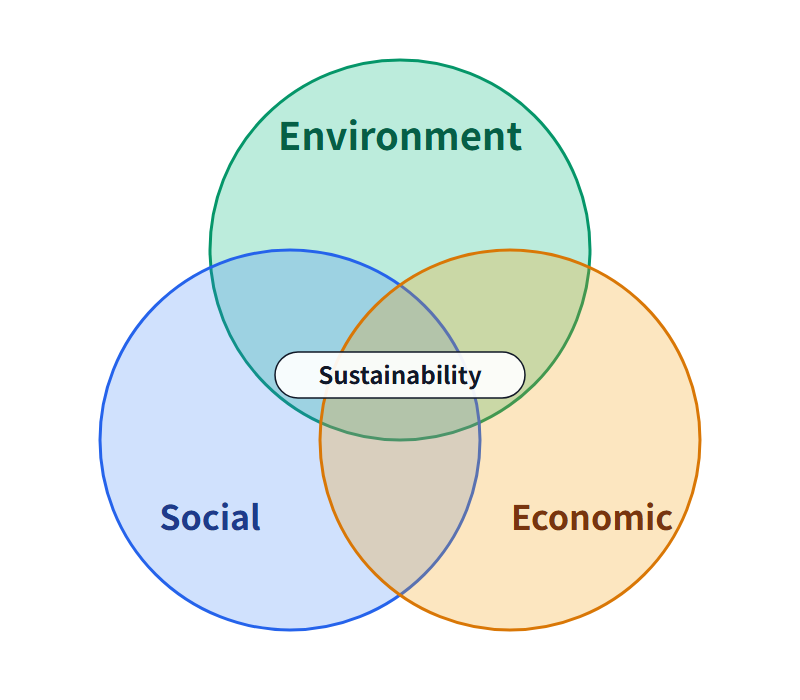 (Figure: sustainability as the overlap of environmental, social and economic concerns)