台湾の研究チーム(Chen et al., 2025)は、プロバスケットボールの観客への調査から、観客どうしが一緒に試合の価値を作る度合いを測る12の質問を作りました。これまでの「価値共創」の研究は、企業とお客さまの関係を見るものが中心で、観客と観客の関係を測る物差しはありませんでした。けれどもスタジアムでは、隣の席の人の声や拍手も、その日の試合の一部です。
On 6 October, the Los Angeles Kings of the National Hockey League opened their home season. Beforehand, the club announced that its supporters' group, the Royal Army, would debut a new signature moment during the team introductions, and that the moment was being developed together with the club's game presentation staff. Team introductions are usually a part of the evening that the club designs on its own. Here, part of it was handed to the fans. The atmosphere of a match is not made by the club alone.
The Royal Army became the club's official supporters' group in 2021 and brings drums, flags and chants to home games.
A research team in Taiwan (Chen et al., 2025) surveyed spectators at professional basketball games and developed 12 questions that measure how far spectators create the value of a match together. Earlier research on "value co-creation" mostly looked at the relationship between a company and its customers; there was no yardstick for the relationship between one spectator and another. Yet in a stadium, the voices and applause of the people in the next seats are part of that day's match.
The questions fell into three groups. The first, "event atmosphere", asks whether the players' performance, the fixture and the home crowd spark interaction between spectators. The second, "word of mouth", asks whether people would recommend the games to others, to their family and to people of their age. The third, "spectator interaction", asks whether talking with companions and other spectators makes watching more enjoyable. The authors note that event atmosphere does not appear in value co-creation research from other industries, and describe it as specific to spectator sport.
For clubs, this means spectators can be seen not only as people who receive a service but as people who help to create the experience. The authors give the example of experienced spectators explaining the game to first-time visitors. Whether a newcomer comes back may depend not only on what the club puts on, but also on the time they spent with the people around them.
Bad comments mattered more than good ones
The same paper also tested whether information on social media changes this value co-creation. Participants watched a match stream with positive comments about the team, negative comments, or information unrelated to the match. Those who saw positive comments answered much like those who saw unrelated information. Those who saw negative comments gave somewhat lower answers on all three groups. A "second screen", showing comments in the corner of the stream, was also tested, but no clear difference was found.
The authors suggest that fans are often already strongly attached to their team, so good news adds little on top. Telling people who already love the team something positive does not change their feelings much. Negative news, however, can chip away at the enjoyment of the day and at their willingness to recommend the games.
What follows from this is that paying attention to information that damages the spectator experience may matter as much as adding positive stories on social media. When complaints spread after a match, how does the club take them on board and use them for the next fixture? Before working out how to add to the atmosphere, it may be worth working out how not to take away from it.
What we do not know yet
The study was carried out with basketball spectators in Taiwan. Whether the same three groups appear among football spectators, or among spectators in Japan or the UK, has not yet been tested. The social media experiment was also run on a screen rather than inside a stadium. In addition, many of the questions ask for the respondent's view, in the form of "I believe that ... increases interaction among spectators".
The study also did not test whether value co-creation among spectators leads to the intention to attend again or to stronger attachment to the team, which the authors list as a task for future research. In other words, we cannot yet say that a lively crowd brings more people back.
Even so, with a yardstick in hand, a club can check this with its own spectators. It could, for example, ask the same questions before and after an initiative such as a moment created with its supporters' group, and see which of the three groups moved, and whether those spectators came to the next match. How much will the Kings' new introductions move the people around them to want to come back?
At Enfinitics, we are building "enfi" (beta in preparation), a tool that lets clubs measure their own spectators with yardsticks like this one from research. → enfi.enfinitics.com
Sources
Chen, C.-Y., Lin, Y.-H., Yang, C.-Y., Chou, Y.-L., & Yeh, T.-Y. (2025). Value cocreation among spectators in professional spectator sports events: Scale development and effects of social media strategies. PLOS ONE, 20(5), e0320927. https://doi.org/10.1371/journal.pone.0320927


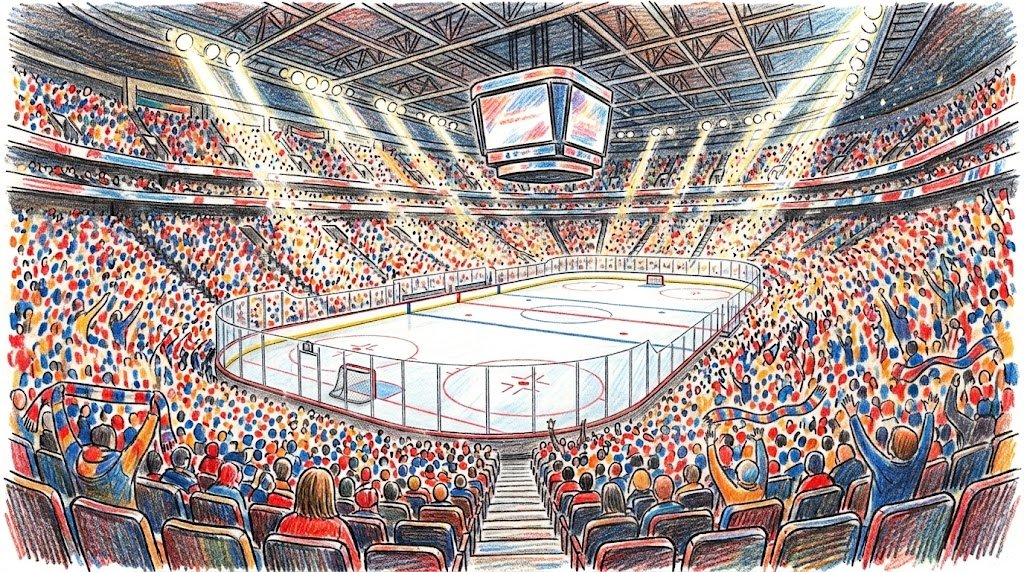
 LA Kings Welcome Royal Army to STAPLES Center | Los Angeles Kingsnhl.com