ここまで見てきたことには、大きな限界がある。3.と4.の研究は、飲食店とホテルが対象で、しかも多くはYelpやトリップアドバイザーのデータだ。マイナークラブのスタジアムで、Googleマップの情報を整えたら観客が増えたかを確かめた研究は、筆者の調べた範囲では見当たらない。 スポーツに近い研究としては、欧州の17のスタジアムについてトリップアドバイザーの口コミ2万6千件あまりを分析し、訪れた人の体験がチームのブランドのイメージに強く結びついていることを示したものがある(Ramos et al., 2023)。ただし、これも大きなクラブのスタジアムと、観光で訪れた人の口コミである。
Today, even the smallest club can use social media to make its name known in distant towns and other countries. A goal clip can travel around the world overnight, and fans on the other side of the planet are no longer unusual. Big clubs have the systems and budgets to market themselves to the whole world as a matter of course.
For minor clubs playing in regional or lower leagues, however, the real support lies elsewhere. It comes from the people who turn up every week, buy tickets, buy a drink at the kiosk and volunteer on match days. Most of them live within walking, cycling or bus distance of the ground. A minor club survives because local people recognise it and stand behind it.
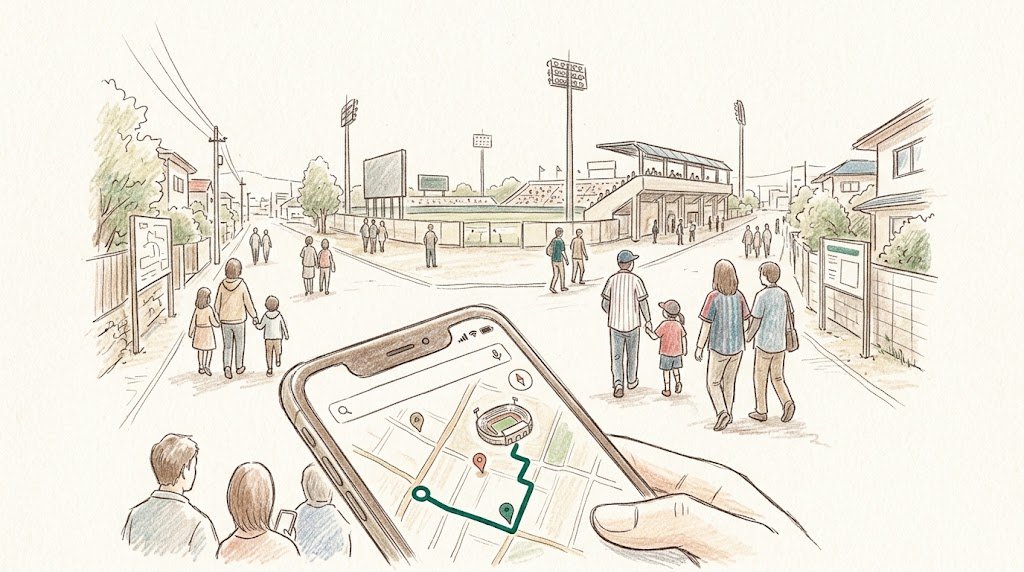
So have community-rooted clubs already reached everyone they could in their own area? The author doubts it. Even a club that joins local events, visits schools and works with local businesses probably has many people living a few kilometres away who have never been to a match. The opportunity is hiding in plain sight. This article looks at a tool most people already carry on their phones — Google Maps — as a way to reach them. Can a map really help a minor club bring people in?
1. Why Google Maps, and not just any review app?
Some will say that reviews are reviews, whichever app they are on. But Google Maps is a different kind of thing from a review app. The biggest difference is why people open it. People open a review app when they have already decided to look for somewhere to go; they open Google Maps to find the way, check a meeting point or look up a train time. According to Google, more than two billion people use Google Maps every month. A ground can catch the eye of people who were not looking for it — and those people are exactly the "not yet" fans a minor club wants to reach.
The second difference is that the map is tied to search. Search Google for a venue's name, or for "near me", and the results show the same information, photos, star rating and reviews as the map. Google's own help pages explain that a business's profile appears on both Search and Maps. A study of US restaurants points out that Google Search shows ratings from Google's own platform, Google Maps, rather than from other review sites (Li & Hecht, 2021). The first rating a local resident sees is, in many cases, the Google Maps one.
The third is that a different review platform means a different set of places in view. The same study found that the same restaurants scored on average about 0.7 stars higher on Google Maps than on Yelp, a US review site, and that the top ten restaurants in a city barely overlapped between the two (Li & Hecht, 2021). Review platforms, in other words, are not interchangeable: where a place appears, and how it looks there, changes which places customers see. Getting things right on the platform local people use most carries a weight no other site does.
On top of that, Google Maps takes you from finding a place to getting there in a single screen. You see the rating and photos, then check the route, the walking time or which bus to take, without switching from a review app to a separate map. And one more thing: most grounds are already on the map, with reviews from people who have been, whether or not the club has done anything. The club's front door on the map is already open, tended or not.
2. Where do people decide to "give it a try"?
What do we usually do before walking into a café for the first time? We search for it, or for "cafés near me", on a map; we look at the photos, read the stars and reviews, and check the opening hours and how to get there. A map is no longer just for finding the way; it has become the place where we decide where to go.
Research supports this. People mainly read online reviews to save time and make better choices (Hennig-Thurau & Walsh, 2003). People who write reviews are motivated by concern for other customers, enjoyment of social interaction and a wish to make their experience useful (Hennig-Thurau et al., 2004). A review is a kind of guide written by someone who has been, for someone who has not.
Some studies use Google Maps reviews themselves as data. One study analysed more than 900,000 Google Maps reviews of over 5,000 restaurants in London, Birmingham and Manchester. It read four elements of the experience — food, service, atmosphere and value — from the review text and examined how they relate to star ratings (Mathayomchan & Taecharungroj, 2020). Review text contains what star ratings alone cannot show: what the experience was actually like.
To local people, a stadium is one of many weekend options, compared on the same map as cafés, cinemas and parks. A club may assume that "locals already know us", but whether someone decides to go may depend on what the map shows the first time they look.
3. Have maps and reviews moved customers in other industries?
Whether reviews really change customer numbers has been studied most in restaurants. A study of restaurants in Seattle, using state tax records to measure revenue, found that a one-star rise in rating brought a 5–9% rise in revenue (Luca, 2016). What stands out is that the effect appeared only for independent restaurants, and hardly at all for chains. With a well-known chain, customers can picture what they will get without reading reviews. The less known a place is, the more customers rely on reviews to decide.
Another study, of restaurants in San Francisco, found that just half a star more made restaurants noticeably more likely to be fully booked (Anderson & Magruder, 2012). And a meta-analysis — a method that combines the results of many studies to see the overall pattern — of 96 studies found that the link between reviews and sales is not strong overall but clearly positive, and that the number of reviews was more strongly linked to sales than the average star rating (Babić Rosario et al., 2016).
The Seattle and San Francisco studies, however, used data from Yelp. As section 1 showed, the first rating local people see today is often the Google Maps one. It seems natural to think that the mechanism these studies found — ratings moving customer numbers for lesser-known places — now plays out largely on Google Maps. Studies that test this in the same way on Google Maps are still few.
Public bodies have noticed the map's role too. In 2022, Tochigi Prefecture in Japan ran a project to help local tourism businesses share information effectively on Google Maps, including seminars on Google Business Profile (the tool that lets a business manage how it appears on the map). According to the company contracted to deliver it, the background was that tourists choose where to eat using Google Maps, yet the information on the map for tourist sites and restaurants was often lacking — partly because businesses had not claimed their profiles. This is not a success story with figures; no results have been published. Still, the fact that those responsible for local tourism treated "tidying up how we look on the map" as part of getting ready for visitors, and made a project of it, is a useful pointer for minor clubs. And if, as Luca's study showed, it is lesser-known places that people rely on reviews for, the map may matter most not to big clubs but to minor ones.
4. Is it worth replying to reviews?
Reviews can be good or bad. What should a club do when it finds a negative one? There is research on this question, from hotels. It compared the same hotels on TripAdvisor, where hotels often reply to reviews, and Expedia, where they rarely do, and looked at how ratings changed before and after the hotels started replying (Proserpio & Zervas, 2017).
Hotels that began replying saw their ratings rise by about 0.12 stars on average, and the number of reviews rose by just over 10%. That is not a big difference, but where a fraction of a star can change rankings and impressions, it is not small either. Interestingly, the authors explain the rise not by hotels getting better but by a change on the reviewers' side: once guests know the hotel replies, unhappy guests write differently.
What matters is that a reply works as a signal — "we are listening" — rather than as an excuse or a counter-argument. Thank people for good reviews; for bad ones, acknowledge what happened and briefly say what will change. The person who wrote the review is not the only reader. So are people the club has never met, who are deciding whether to come.
This is hotel research, of course, and sports clubs may not see the same result. But replying costs almost nothing. Even a minor club with few staff can reply to new reviews once a week. "Replying to every review" may be one of the few things a small club can do better than a big one.
5. What a minor club can start doing tomorrow
Google Business Profile, the tool for managing how a business or venue appears on Google Maps, lets owners publish "updates", "offers" and "events" and add a button linking to a website. Event posts can carry dates and times, and posts older than six months are archived automatically. The information on the map goes stale unless someone keeps tending it.
First, create a shortcut to tickets and fixtures, so that someone who finds the club on the map can get straight to the next match date and how to buy a ticket. Second, post before and after matches: for example, a photo and "see you at the ground" the day before, and thanks to everyone who came, with a request for a review, afterwards. Third, grow the number of reviews and reply to all of them. Simply asking first-time visitors, "If you enjoyed it, would you leave a review?" may change the count.
Fourth, measure. Google Business Profile shows how often the page was viewed, which words people searched for, and how many requested directions, called or clicked through to the website. Recording how these numbers change between the month before posting begins and the months after will at least show whether people are finding the club on the map. The number of people requesting directions is a useful hint at how many set off for the ground.
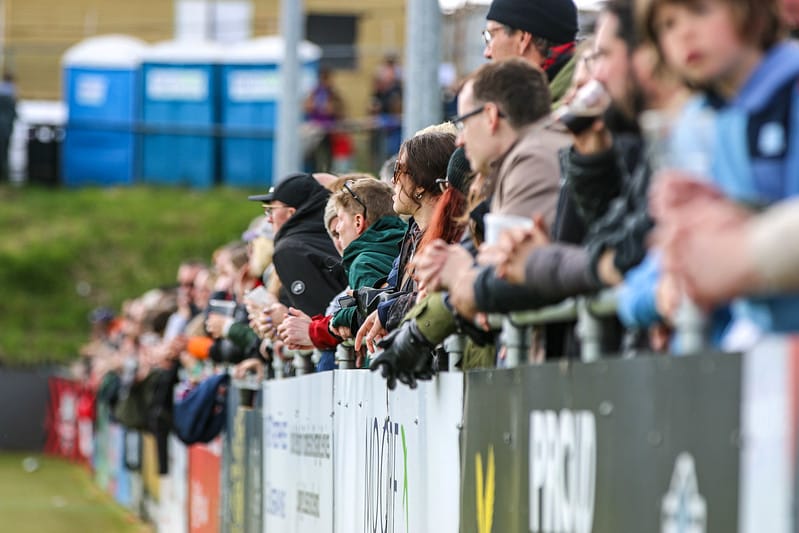
Take, for example, a small club in the south of England that the author once looked at: Lewes FC, owned by local people since 2010. In the 2023/24 season, 34,430 people attended its men's and women's competitive home games, a club record (according to the club). But that figure grew out of the club's local ties and has nothing to do with maps; this club did not succeed through Google Maps. In fact, when the author looked in autumn 2024, the club's and the ground's Google Maps pages had hardly been updated. Even a club with strong local support may leave its front door on the map untouched — not out of laziness, but because staff time goes to running matches and community work. That is exactly why making existing local ties visible on the map is room for growth that needs no new spending. None of these steps costs much; what they need is a little time each week.
Everything above has a big limitation. The studies in sections 3 and 4 looked at restaurants and hotels, mostly using data from Yelp or TripAdvisor. The author could find no study that tested whether improving a minor club's Google Maps listing actually increased attendance. The closest research to sport analysed more than 26,000 TripAdvisor reviews of 17 European stadiums and found that visitors' experiences were strongly linked to the image of the team's brand (Ramos et al., 2023). But that, too, concerned big clubs' stadiums and reviews by tourists.
The map's numbers have limits too. Even if views and direction requests rise, the map cannot show whether those people actually came to the ground, or whether they came back. Nor can it show where a first-time visitor decided to return — the match, the atmosphere, a kind word at the kiosk. A map tells you how many came to the entrance, not what happened inside.
Moreover, reviewers are only some of the people who came. The very happy and the very unhappy are more likely to write, and the many in between leave little trace. Judging a club's matchday experience by reviews alone risks being pulled towards the views of a vocal few.
The honest answer to "is Google Maps effective for attracting spectators?" is this: it is likely to help widen the entrance, but no one has yet properly tested whether it increases attendance. That is why clubs that tidy up their map listings should also build their own way of checking — for example, asking ticket buyers and first-time visitors "How did you hear about us?" — alongside the map's own numbers.
7. The author's view: can a map become the club's front door?
From here on, this is the author's view rather than a research finding. Marketing for minor clubs often turns into a conversation about gaining social media followers. But if a club's strength is local support, shouldn't it look first not at "somewhere in the world" but at "the people within a few kilometres who have not yet come"? They don't follow the club on social media, but they open a map almost every day.
A club's page on the map can become a front door for local people. There are fixtures, photos, and replies from someone at the club who has clearly read the reviews. That may be the most everyday way of telling people outside the ground that "this club listens to local voices". The values of a community club and a map that local people use every day are a natural fit.
But the map is only the entrance. Whether a first-time visitor comes back depends on the matchday experience itself, and reviews are written after that experience. In the author's view, tidying up the map and improving visitors' experience are not two separate jobs but one continuous job.
Conclusion: are you ready to welcome the fans on your doorstep?
Precisely because social media can reach the whole world, a minor club's next fans may be surprisingly close. They may have heard the club's name but never walked through its gates. And every day, they open a map on their phone to find their way.
Research tells us that reviews are read, that ratings move customer numbers most for lesser-known places, and that replying may lift ratings a little. And the first rating local people see is, in many cases, the one on Google Maps. Whether that brings more spectators to small sports clubs, however, has not yet been tested. If clubs that tidy up their maps ask visitors "How did you hear about us?" and "Would you come again?", and collect the answers, this question can finally be answered.
The fans on your doorstep are already on the map. Is the club ready to welcome them? And shouldn't we also measure properly what people who found the club on a map felt at the ground, and whether they want to come back?
Sources
Anderson, M., & Magruder, J. (2012). Learning from the crowd: Regression discontinuity estimates of the effects of an online review database. The Economic Journal, 122(563), 957–989. https://doi.org/10.1111/j.1468-0297.2012.02512.x
Babić Rosario, A., Sotgiu, F., De Valck, K., & Bijmolt, T. H. A. (2016). The effect of electronic word of mouth on sales: A meta-analytic review of platform, product, and metric factors. Journal of Marketing Research, 53(3), 297–318. https://doi.org/10.1509/jmr.14.0380
Hennig-Thurau, T., Gwinner, K. P., Walsh, G., & Gremler, D. D. (2004). Electronic word-of-mouth via consumer-opinion platforms: What motivates consumers to articulate themselves on the Internet? Journal of Interactive Marketing, 18(1), 38–52. https://doi.org/10.1002/dir.10073
Hennig-Thurau, T., & Walsh, G. (2003). Electronic word-of-mouth: Motives for and consequences of reading customer articulations on the Internet. International Journal of Electronic Commerce, 8(2), 51–74. https://doi.org/10.1080/10864415.2003.11044293
Li, H., & Hecht, B. (2021). 3 stars on Yelp, 4 stars on Google Maps: A cross-platform examination of restaurant ratings. Proceedings of the ACM on Human-Computer Interaction, 4(CSCW3), 1–25. https://doi.org/10.1145/3432953
Mathayomchan, B., & Taecharungroj, V. (2020). "How was your meal?" Examining customer experience using Google Maps reviews. International Journal of Hospitality Management, 90, 102641. https://doi.org/10.1016/j.ijhm.2020.102641
Proserpio, D., & Zervas, G. (2017). Online reputation management: Estimating the impact of management responses on consumer reviews. Marketing Science, 36(5), 645–665. https://doi.org/10.1287/mksc.2017.1043
Ramos, R. F., Biscaia, R., Moro, S., & Kunkel, T. (2023). Understanding the importance of sport stadium visits to teams and cities through the eyes of online reviewers. Leisure Studies, 42(5), 693–708. https://doi.org/10.1080/02614367.2022.2131888


 Google Maps now has over 2 billion monthly users9to5Google
 Three records smashed! Lewes FC ticketing takeaways 2023/24lewesfc.com